Introduction to Reverse Osmosis Water Treatment Equipment
As a key technology in modern pure water production, reverse osmosis water treatment systems achieve water purification through the coordinated operation of three precision systems. The pretreatment system handles initial purification, the reverse osmosis purification system achieves deep desalination, and the ultrapure post-treatment system fine-tunes water quality according to specific requirements. This integrated process ensures a seamless transformation from ordinary water sources to high-purity water.
Core Technology Principle
Reverse osmosis technology utilizes the principle of precision membrane separation. By applying an operating pressure exceeding natural osmotic pressure on the concentrated solution side, water molecules are forced to permeate in the reverse direction. This process effectively retains over 98% of dissolved salts and organic compounds with molecular weights exceeding 100, while allowing water molecules to pass through the membrane structure.
With pore sizes smaller than 1.0 nanometers, reverse osmosis composite membranes completely filter out microbial contaminants including Pseudomonas aeruginosa (3000×10⁻¹⁰m), influenza viruses (800×10⁻¹⁰m), and even pyrogens (10⁻⁵⁻⁵×10⁻¹⁰m). This physical separation method requires no phase change, consumes significantly less energy than traditional distillation processes, and produces no chemical wastewater, meeting green environmental standards.
Detailed Explanation of the Pretreatment System
Serving as the “guardian” of the reverse osmosis system, the pretreatment stage typically includes four levels of filtration assurance:
The quartz sand filter acts as the first line of defense, primarily removing visible contaminants such as suspended particles, colloidal impurities, and silt, significantly reducing water turbidity.
Activated carbon filters leverage their abundant surface functional groups to specifically adsorb residual chlorine, odor-causing organic compounds, and pigments, effectively enhancing water taste and safety.
The softening unit employs ion-exchange resin to replace calcium and magnesium ions in water, fundamentally resolving hardness issues and preventing membrane surface scaling and blockage.
The precision filter, equipped with a 5-micron PP cartridge, serves as the final barrier before reverse osmosis, ensuring complete interception of any particles larger than 5 microns.
Core Purification Unit
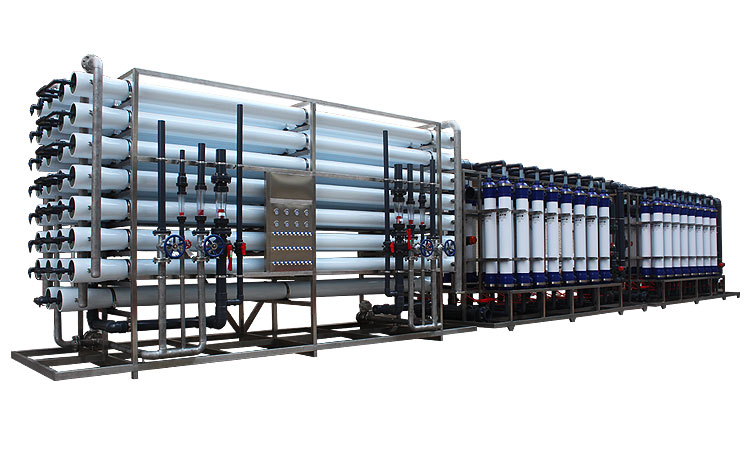
The reverse osmosis core unit comprises a high-pressure pump assembly, membrane element array, and pressure vessel. As pressurized water flows over the membrane surface, a portion permeates to form purified water, while dissolved solids are continuously concentrated and discharged. This design enables sustained production of high-quality purified water while concentrating contaminants for removal.
In actual operation, system recovery rates vary: residential units typically maintain a 3:1 wastewater ratio; industrial-grade equipment can be optimized to 1:1; large-scale systems may achieve even lower wastewater production rates. Note that excessively pursuing low wastewater ratios significantly increases operating costs and shortens membrane lifespan.
System Maintenance Essentials
A comprehensive maintenance system ensures long-term stable operation:
Establish daily monitoring protocols, focusing on recording conductivity, pressure parameters, and flow data to promptly detect abnormal fluctuations.
Standardize consumable replacement cycles: quartz sand should be renewed every 10-24 months, activated carbon and resin annually, and precision filter cartridges every 3-6 months.
Maintain equipment cleanliness, regularly inspect pipeline seals, and ensure stable water and power supply. Pay special attention to system restart settings after power outages to prevent equipment failure due to misoperation.
Emergency Response Plan
During unexpected outages when the reverse osmosis system fails to produce water, activate the softened water supply mode to meet basic water demands. In case of severe leaks, immediately shut off the inlet valve and power supply, then contact professionals for repairs. Consider replacing core filter media when post-membrane pressure exceeds 1.5MPa or product water conductivity surpasses 15μS/cm.
Application Scenarios Overview
This technology has been deeply integrated into multiple critical sectors:
- Power Industry: Boiler feedwater and cooling systems
- Electronics Industry: Semiconductor cleaning and ultrapure water requirements
- Food & Pharmaceutical: Ensuring production process water quality
- Beverage & Chemical: Providing high-standard formula water
- Civil Infrastructure: Achieving deep purification of drinking water
- Marine Applications: Solving water supply for vessels and islands
- Environmental Protection: Supporting heavy metal recovery and water resource recycling
The widespread adoption of reverse osmosis technology is driving continuous improvements in water quality standards across industries, delivering reliable water quality assurance for both production and daily life. Through scientific maintenance and proper operation, this system can consistently produce high-purity water over the long term, meeting diverse water requirements across various applications.
 Why is reverse osmosis the “gold standard” for advanced water purification?
 The ultimate leak prevention guide for home water filtration systems...
 The Purification Principle of Reverse Osmosis Water Filters and Nutritional Insights on Purified Water
 What Contaminants Affect Reverse Osmosis Equipment