Selecting Types and Flux for Reverse Osmosis Design in Pure Water Equipment
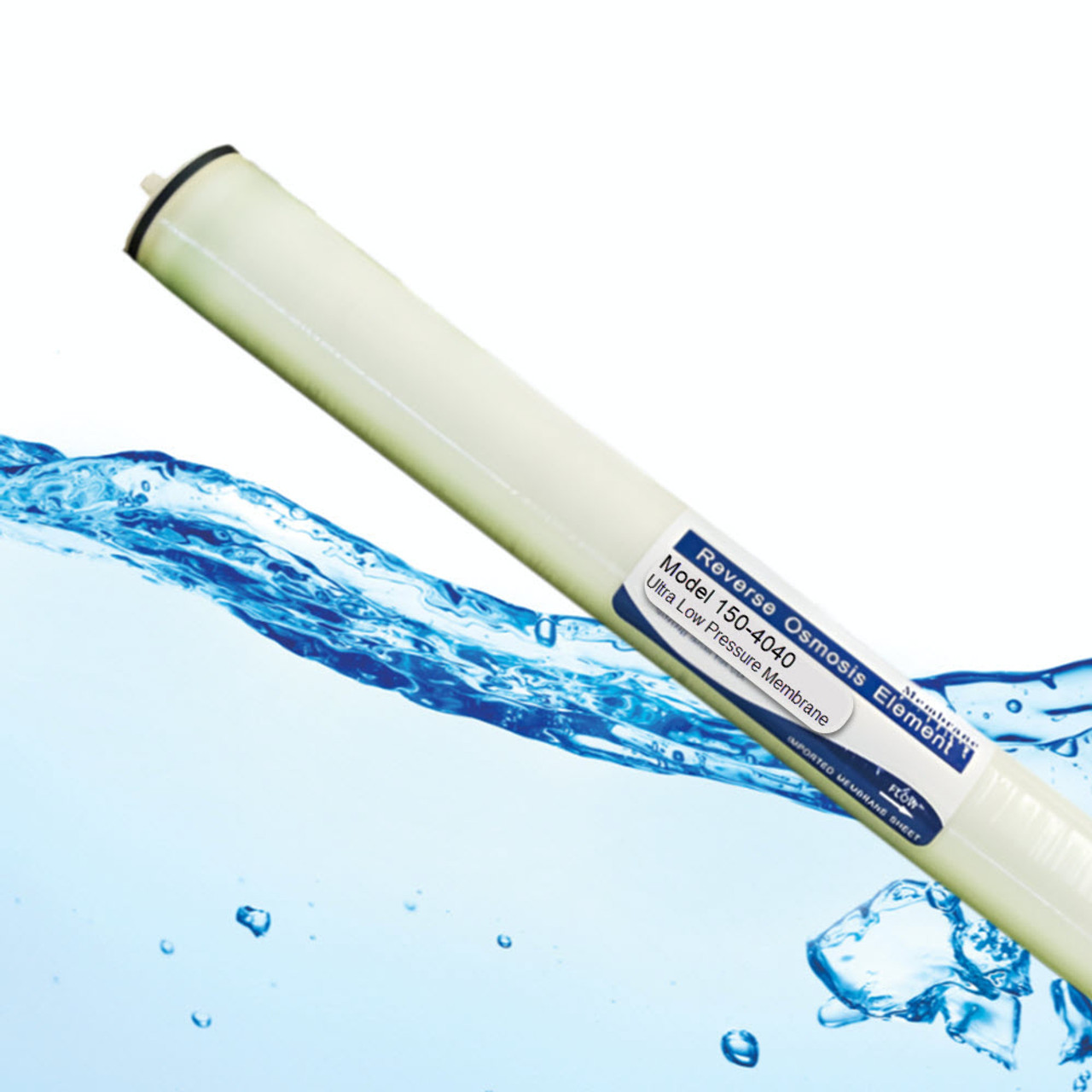
Two common reverse osmosis membrane models are frequently used in reverse osmosis equipment: the 4040 reverse osmosis membrane and the 8040 reverse osmosis membrane. So, which model should be selected for optimal performance? This is the key issue we will address next.
Since pure water equipment incorporates two distinct membrane models in its design, their applications must differ. To maximize the performance of both models, rational allocation is essential.
How to choose between 4040 and 8040 reverse osmosis membranes? According to the manufacturer's design guidelines, their recommended average water flux rates are: 8-14 gfd (using surface water as feed source), 14-18 gfd (using groundwater as feed source), and 20-30 gfd (using the permeate from a primary RO system as feed for a secondary RO system).
Per these guidelines, the minimum water production for a single 8040 reverse osmosis membrane is 0.46 t/h (using surface water as feed), 0.80 t/h (using groundwater as feed), and 1.15 t/h (using the product water from a primary RO system as feed for a secondary RO system). Theoretically, 8040 RO membranes can be used when the system's water production exceeds these values. However, the decision to adopt 8040 RO membranes must also consider factors such as the system's required recovery rate, whether concentrate recirculation is permitted, system footprint, pressure vessel costs, and overall system economics.
Based on a comprehensive balance of these factors, it is generally considered appropriate to use 8040 reverse osmosis membranes for systems above 5 t/h. For 3-5 t/h systems, either 8040 or 4040 membranes can be used. For a 1 t/h system, several 4040 reverse osmosis membranes should be selected.
As previously explained, the design permeate flow rate of each RO membrane is unrelated to its standard permeate flow rate but depends solely on its effective area and the SDI value of the feed water source. The effective area of a 4040 RO membrane is typically 85 ft². Its recommended average permeate flux ranges from 8-14 gfd (when using surface water as the feed source), 14-18 gfd (when using groundwater as the feed source), 20-30 gfd (when using the permeate from a primary RO system as feedwater for a secondary RO system). Therefore, when using surface water as feedwater, the design permeate flow rate of the 4040 RO membrane = (8-14 gfd) × 85 ft² = 680-1190 gfd, equivalent to 107-187 L/h. Similarly, when using groundwater as the feed source, the design water production of the 4040 reverse osmosis membrane is 187-241 L/h.
When using the permeate from a primary RO system of a pure water plant as feed for a secondary RO system, the design permeate flow rate for 4040 RO membranes is 268–402 L/h. If a designer plans to build a 1 t/h RO system using 4040 RO membranes with surface water as feed, the required number of 4040 RO membranes can be estimated as follows:
Number of RO membranes = System water production / 4040 RO membrane water production i.e., Number of RO membranes = (1 t/h) / (107-187 L/h) = 10-6 units. Similarly, when using groundwater as the feed source, the system should be designed with 6-5 RO membranes.
When using the product water from the first-stage reverse osmosis system as feedwater for the second-stage reverse osmosis system, the number of reverse osmosis membranes designed for this system should be 4-3 units.
The design guidelines provided by reverse osmosis membrane manufacturers are recommendations based on their understanding of their products and years of practical application experience. If users design and operate systems according to these guidelines, the manufacturers will provide a 3-year quality warranty for their products. However, the guidelines only specify a range for the design water production rate; designers should make decisions based on their own experience and actual operating conditions.
Some designers or operators deviate from the above approach, instead basing their designs or operations solely on the standard water production rates provided by the membrane manufacturer. When using groundwater or surface water as the feed source, this practice often results in excessively high average water flux for the system. This can cause rapid damage to the reverse osmosis system and invalidate the manufacturer's 3-year quality warranty, making it an unreasonable design approach.
Currently, commercially available 1t/h reverse osmosis systems typically employ four 4040 reverse osmosis membranes, and sometimes even three or two 4040 membranes, without considering the water source.
The design guidelines provided by reverse osmosis membrane manufacturers are based on their understanding of their products and years of practical application experience. These guidelines represent the manufacturers' recommendations. If users design and operate systems according to these guidelines, the manufacturers will provide a 3-year quality warranty for their products. However, the guidelines only specify a range for the design water production rate. Designers should make decisions based on their own experience and actual operating conditions.
Some designers or operators deviate from these principles when designing or operating reverse osmosis systems. Instead of following the aforementioned approach, they base their designs or operations solely on the standard water production rates provided by the membrane manufacturer. When using groundwater or surface water as the feed source, this practice often results in excessively high average water flux for the system. This can lead to rapid damage of the reverse osmosis system and simultaneously invalidate the three-year quality warranty provided by the membrane manufacturer. Therefore, such designs are considered unreasonable.
Currently, commercially available 1t/h reverse osmosis systems typically employ four 4040 reverse osmosis membranes, and sometimes even three or two 4040 membranes, without considering the impact of various factors such as the water source. Consequently, these designs are not entirely reasonable and may also invalidate the three-year quality warranty provided by the reverse osmosis membrane manufacturer for their products. However, this design is widely accepted primarily due to its economic advantages. Moreover, in many cases, such configurations can operate for extended periods.
 The 4 Major Culprits Behind Industrial Reverse Osmosis Membrane Blockage + The Ultimate Solution—90% of People Are Doing It Wrong!
 How to Protect Reverse Osmosis Water Purifier system During Shutdown?
 How to Determine Whether to Use 4“ or 8” Membrane Elements for Reverse Osmosis?
 Commercial Water Purification Solutions for Coffee/Tea Establishments