Water purification information

Water Purifier

Views : 135647
Update time : 2021-09-29 11:50:34
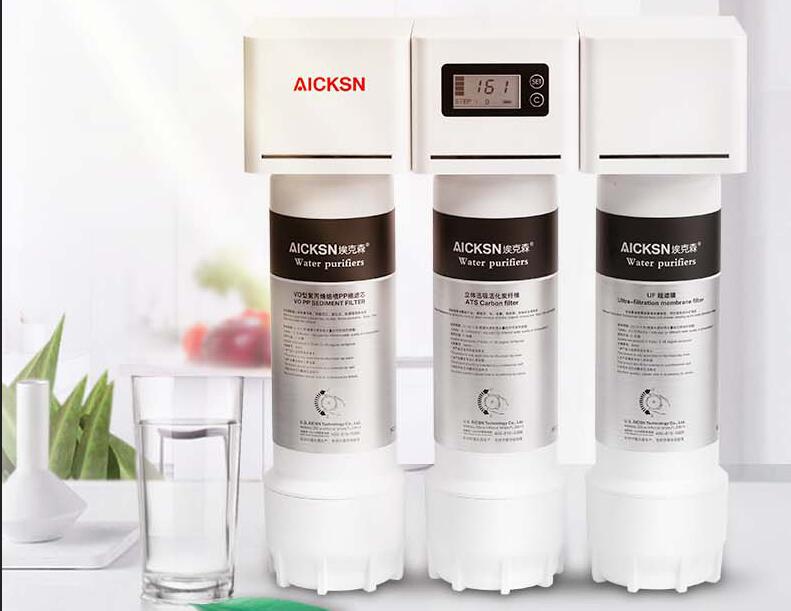
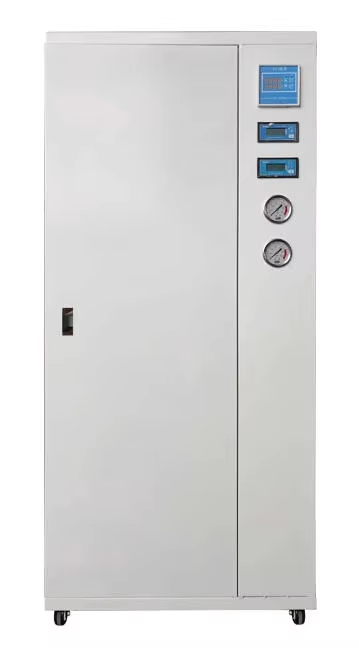
Water purifier, also called water purification machine, is a water treatment equipment that performs deep filtration and purification of water according to the requirements of water use. Water purifiers usually refer to small purifiers used in households.

The core of its technology is the filter membrane in the filter element device. The main technology comes from three types: ultrafiltration membrane, RO reverse osmosis membrane, and nanofiltration membrane.

Water purifier function
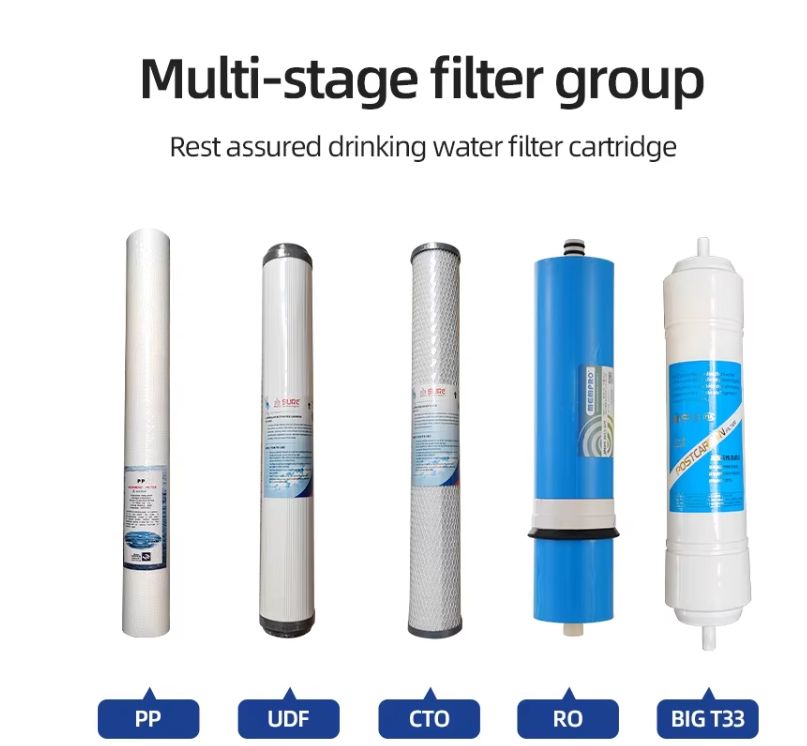
The function of the water purifier is to remove floating objects, heavy metals, bacteria, viruses, residual chlorine, silt, rust, microorganisms, etc. The first level is the filter element, also known as PP cotton filter element (PPF), the second level is granular activated carbon (UDF) filter element, the third level is precision compressed activated carbon (CTO) filter element, and the fourth level is reverse osmosis membrane or ultrafiltration membrane. The fifth level is the post activated carbon (small T33). The water purifier is not only suitable for areas with serious tap water pollution, but also can filter the residual chlorine in conventional tap water, and at the same time can improve the taste of water.
Water purifier
Working principle of water purifier
The first level: PP cotton: remove all kinds of visible objects/dust and impurities in tap water.
The second and third stage: pre-activated carbon: part of the third stage of low-profile water purifier is also PP cotton, carbon to remove chlorine and organic impurities. It can also absorb the peculiar smell, color and smell produced by organic compounds in the water.
The fourth level: ultrafiltration or reverse osmosis membrane: the membrane can remove bacteria, viruses, spores and other substances in the water.
The fifth level: post activated carbon device: to further improve the taste and remove peculiar smell.
Most water purifiers adopt a progressive structure method based on the principle of blocking filter filtration, which is composed of multi-stage filter elements connected in series, and the filter elements are arranged in order from low to high precision to realize multi-stage filter elements to share and intercept the dirt, thereby reducing filter element clogging And the number of manual drainage, disassembly and washing, and extension of the replacement cycle of the filter element. There is also a new design idea that applies the principle of quality distribution and self-cleaning structure. Its design idea is no longer to provide as much space as possible for collecting dirt, but to adopt the principle of quality separation to separate a small amount of dirt. Part of the clean water, and at the same time, let the raw water circulate as much as possible so that the pollutants can be taken away with the water in time, so that the water does not rot. In this way, purified water is obtained, and it will not or be difficult to deposit dirt in the machine, avoid secondary pollution and greatly reduce the loss of filter elements, and the water quality is better, safer, and energy-saving and low-carbon. This new principle self-cleaning water purifier won the Gold Award at the 7th International Exhibition of Inventions. It has a one-in-two-out structure. It improves the impurity concentration of the raw water in the machine due to the structural defects of one in and one out of the traditional water purifier. The more it accumulates, the higher it eventually becomes sewage. Therefore, the concept of self-cleaning water purifiers without sewage and sewage water purifiers is replaced by washing water. With the improvement of living standards, the popularity of water purifiers will become wider and wider, and new technology products are better meeting people's needs.
Related News
Read More >>
A Comprehensive Guide to Pure Water Production Core Processes: Understanding the Role of Each Stage from Coarse Filtration to EDI A Comprehensive Guide to Pure Water Production Core Processes: Understanding the Role of Each Stage from Coarse Filtration to EDI
Jan .09.2026
Understanding the working principles of each fundamental unit is the cornerstone for proper equipment selection, efficient operation, and effective troubleshooting.
Nine Core Water Treatment Technologies: How Your Pure Water Is Made Nine Core Water Treatment Technologies: How Your Pure Water Is Made
Jan .09.2026
In modern water treatment systems, nine core technologies each play their part, functioning like a precision assembly line to transform ordinary raw water into purified water that meets diverse needs.
What are the differences between common types of water used in laboratories? What are the differences between common types of water used in laboratories?
Jan .08.2026
What are the differences between common types of water used in laboratories? (Ultrapure water, deionized water, RO water, distilled water, double-distilled water)
How to Choose Laboratory Water? Deionized Water, Double-Distilled Water, or Ultrapure Water? How to Choose Laboratory Water? Deionized Water, Double-Distilled Water, or Ultrapure Water?
Jan .08.2026
The core distinctions between different types of laboratory water (such as ultrapure water, deionized water, RO water, etc.) ,which directly impact their suitability for various experiments.