Regarding High Efficiency Reverse Osmosis (HERO), while it is occasionally mentioned in ultra-pure water preparation or near-zero liquid discharge (NZLD) projects, its specific details are rarely shared. Therefore, today we take this opportunity to briefly introduce some fundamental concepts of HERO and its applications in the field of water treatment.
First, the Origins of HERO
Between 1996 and 1997, Indian-American engineer Debasish Mukhopadhyay proposed a composite reverse osmosis process—characterized primarily by ion exchange for hardness removal and high-pH RO operation (pH > 8.5)—namely the High Efficiency Reverse Osmosis (HERO) process. Deb, as the sole inventor and patent holder, secured the patent (US5,925,255). Initially, the HERO process was primarily used for ultrapure water production. By ionizing silica at high pH levels, it enhanced the silica rejection rate of reverse osmosis membranes while achieving higher system water recovery rates.
Later, Aquacore Corporation adopted it as its flagship membrane concentration process for zero-liquid discharge projects, propelling HERO to prominence. Coincidentally, Texaco also filed a combined reverse osmosis patent (US5,250,185) in 1992, featuring demineralization and high-pH RO operation (pH>9.5). This combined process was initially applied for boron removal from produced water in oilfields.
Subsequently, Veolia acquired an exclusive license for this patent and developed the Optimized Pretreatment and Unique Separation (OPUS) process based on it, positioning it as their primary membrane concentration technology for zero-liquid discharge projects (Source: Wanmi Space, with minor modifications). Clearly, HERO and OPUS share significant technical similarities.
① In ultrapure water production, both technologies' high-pH operating conditions effectively promote the ionization of elements like silicon and boron, creating favorable conditions for their efficient removal in RO processes.
② In near-zero discharge membrane concentration, both technologies' design philosophies have advanced conventional membrane concentration processes. Concepts such as complete softening, multi-stage concentration, and inter-stage softening have become core principles in mainstream membrane concentration designs.
Note: The following text will not distinguish between HERO, OPUS, and other similar processes or patents. HERO will be used as a unified term for this type of reverse osmosis combination process requiring extremely low feed water hardness (hardness < 1 mg/L) and high pH (8.5–11) operating conditions.
II. Application of HERO in Ultrapure Water Production
In ultrapure water production, as an optimization of conventional RO processes, HERO's primary advantage lies in enhancing silicon and boron removal rates (it also contributes to TOC reduction, primarily through inhibiting microbial growth). However, the most critical control factor remains hardness management (<1 mg/L) to minimize the risk of inorganic salt scaling (primarily calcium carbonate).
(1) Principle of HERO's Efficient Silica Removal
In ultrapure water production, the early objective of the HERO process was to efficiently remove dissolved silica (water-soluble silica). For simplicity, we can approximate its ionization behavior using a conversion equation analogous to the carbonate equilibrium in water:
SiO₂ + H₂O ⇌ H₂SiO₃ ⇌ H⁺ + HSiO₃⁻ ⇌ 2H⁺ + SiO₃(2⁻)
SiO₂: Silicon dioxide
H₂SiO₃: Metasilicic acid (silicic acid), molecular weight 78.1 Da
HSiO₃⁻: Metasilicic acid hydrogen ion
SiO₃(2⁻): Metasilicic acid ion
When silica dissolves in water, it initially forms metasilicic acid, primarily existing in molecular form, resulting in low removal efficiency by reverse osmosis. By gradually increasing the inlet water pH with alkali (NaOH), H₂SiO₃ begins to ionize and exhibits the following states at different pH levels: When pH < 7, it primarily exists as H₂SiO₃; When 7 < pH < 9, H₂SiO₃ and HSiO₃⁻ coexist; When 9 < pH < 10, HSiO₃⁻ and SiO₃(2-) coexist; When pH > 10, SiO₃(2-) predominates.
(2) Principle of HERO's Efficient Boron Removal
Although boron and silicon are not in the same group of elements, boron is adjacent to carbon in the periodic table, while silicon belongs to the same group as carbon. Furthermore, boric acid (the primary molecular form of boron in water, with a molecular weight of 61.8 Da) has a smaller molecular weight (relative to metaboric acid)
(2) The Principle of HERO's Efficient Boron Removal
Although boron and silicon are not elements in the same group, boron is positioned immediately adjacent to carbon in the periodic table, while silicon belongs to the same group as carbon. Furthermore, due to the smaller molecular weight of boric acid (the primary molecular form of boron in water, with a molecular weight of 61.8 Da) compared to metasilicic acid (78.1 Da), standard RO systems demonstrate lower efficiency in boron removal. Boron dissolves in water to form hydrated boron, with the chemical conversion equation as follows: H₃BO₃ + H₂O ⇌ H⁺ + B(OH)₄⁻
H₃BO₃: Boric acid, molecular weight 61.8 Da
B(OH)₄⁻: Borate ion
Similar to carbonate equilibrium, water-soluble boron exists in the following states at different pH levels: When pH < 7, it primarily exists as H₃BO₃. When 7 < pH < 10.5, H₃BO₃ and B(OH)₄⁻ coexist. When pH > 10.5, it primarily exists as B(OH)₄⁻.
During reverse osmosis operation, if the feedwater is neutral or acidic, the removal efficiency of boric acid in the first reverse osmosis stage is only 30%–50%. However, increasing the pH of the reverse osmosis feedwater can rapidly enhance boron removal. For instance, when the feedwater pH is adjusted to above 10.5, the reverse osmosis system can achieve boron removal rates exceeding 90%.
Third, HERO's Application in Near-Zero Discharge (NZD)
In NZD applications, HERO serves as a critical component of membrane concentration processes. Unlike ultra-pure water preparation where key technical metrics focus on boron and silicon removal rates, HERO's core focus in NZD membrane concentration lies in achieving an organic balance between high recovery rates (concentration ratios) and system stability.
(1) Process Advantages of HERO in Membrane Concentration
Unlike ultrapure water projects where feedwater typically originates from high-quality sources like municipal tap water—making thorough softening and organic/microbial control relatively straightforward—
near-zero discharge membrane concentration often handles diverse high-salinity, high-COD wastewater streams. While pretreatment (oxidation, physicochemical processes, biological treatment, advanced oxidation, etc.), achieving near-reclaimed water or even potable water quality is impractical and contradicts the core objectives of membrane treatment (low footprint, high efficiency, low cost).
Therefore, in the near-zero discharge membrane concentration field, the HERO process (HERO is a combined process including softening and RO, not a standalone high-pH+RO process) typically handles complex water with salt content as high as several thousand to tens of thousands of ppm, hardness reaching several hundred ppm, and COD around 100-200 ppm.
Under such complex conditions, ensuring stable HERO system operation hinges on effectively addressing RO fouling issues: inorganic salt scaling (calcium chloride, calcium sulfate, silicates), organic fouling, and microbial growth.
① Inorganic Salt Scaling A (Calcium Salts): Strictly control feedwater hardness through complete softening, maintaining total hardness below 1 mg/L. When feedwater alkalinity (HCO₃⁻) or ion concentrations like sulfate ions [SO₄²⁻] are relatively low, hardness standards may be slightly relaxed. Note: The overall recovery rate of HERO systems often reaches 80-90%, resulting in a concentrate factor of 5-10 times at the concentrate side. The corresponding insoluble salt ion product often reaches 25-100 times (or even 125-1000 times for CaF₂ scaling). Therefore, controlling feedwater hardness at this stage is significantly more challenging and cost-effective than relying on luck.
② Inorganic Salt Scaling B (Silicate): Silicate scale consists of iron and aluminum silicate compounds mixed with silica. Given iron's oxidative and fouling effects on RO systems, it generally requires priority removal. Simultaneously, raising feedwater pH induces a significant shift in silicate equilibrium (effective ionization), effectively reducing scaling risks from silicic acid and its insoluble compounds.
Note: Elevating temperature significantly increases silica solubility, but efficient ionization of dissolved silica (H₂SiO₃) requires high pH operating conditions. Conversely, maintaining water temperature in cold winter regions prevents the lowering of precipitation thresholds for silicic acid and silicate scale due to low temperatures.
③ Organic Fouling and Microbial Growth: HERO's high pH operating conditions effectively inhibit microbial growth and reproduction, preventing the formation of biofilms. Simultaneously, the risk of organic fouling (originating from influent water, primarily measured by COD) is significantly reduced under alkaline conditions—effectively providing continuous alkaline cleaning. Once inorganic scaling, organic fouling, and microbial growth are effectively controlled, HERO's high recovery rate becomes far more achievable. With properly configured RO membrane systems, medium-to-large-scale installations can reliably achieve recovery rates of 80-90%.
(II) Process Challenges for HERO in Membrane Concentration
Alright, alright! Having covered HERO's numerous advantages, it's only fair to address its drawbacks or challenges, right?~
For a considerable time in water treatment, many attributed the stable operation of RO systems solely to the well-designed and reliable pretreatment system. This widely held view stems primarily from equipment failures often occurring when: Designs that disregard raw water quality variations, construction relying on empirical methods or cutting corners (e.g., multi-stage quartz sand distribution, inadequate activated carbon iodine values), and non-professional operations (unauthorized switching between groundwater and recycled water sources, blindly increasing recovery rates) or complete lack of maintenance (running for three years without replacing pretreatment media, operating at only one-third capacity...) —Returning to the main point, as mentioned earlier, the critical prerequisite for HERO's application in near-zero discharge membrane concentration is effective hardness removal, i.e., complete softening.
(1) When raw water hardness ≤ 5 mmol/L (equivalent to 500 mg/L as CaCO₃), a single-stage softening process can achieve ideal effluent hardness ≤ 0.03 mmol/L;
(2) When raw water hardness ranges between 5-10 mmol/L, a two-stage softening process (series configuration) can be implemented to achieve the aforementioned target;
(3) When raw water hardness exceeds 10 mmol/L, it is recommended to first remove the majority of hardness via chemical treatment, followed by ion exchange to eliminate residual hardness.
Considering the above statements and the practical requirements of the near-zero discharge project, the fundamental process logic for basic hardness removal is as follows:
① During the pretreatment stage, employ chemical treatment (adding lime or double alkali, etc.) to reduce the raw water hardness as much as possible before the HERO softening process.
② Given the stringent hardness requirement before the HERO reverse osmosis stage—hardness < 1 mg/L (0.01 mmol/L)—dual-stage or multi-stage softening is both sufficient and necessary.
③ Considering the typically large water volume and complex water quality in such projects, resin selection for multi-stage softening often involves strong acid cation exchange resin (similar to pure water pretreatment softening) + weak acid cation exchange resin.
Note: Strong acid cation exchange resin (SC, primarily targeting high-valent ions like iron and aluminum) is typically placed upfront because industrial wastewater often exhibits low pH and a diverse range of cations. Although SC has lower exchange capacity than weak acid cation exchange resin (WC, primarily targeting divalent ions like calcium and magnesium) and higher regeneration costs, and higher regeneration costs, its adaptability across the full pH range, high dissociation degree (high exchange efficiency), and complete displacement properties offer broader applicability. Under this configuration, the regeneration waste liquid from SC can partially serve as regeneration water for WC, further reducing costs. Specific process selection should still consider other process parameters and comprehensive market pricing.
One final note: Whether in ultrapure water production or near-zero discharge membrane concentration, HERO's alkali consumption under high-pH operating conditions is significant—and that's money!!!
 Introduction to Seawater Desalination Technology—Reverse Osmosis
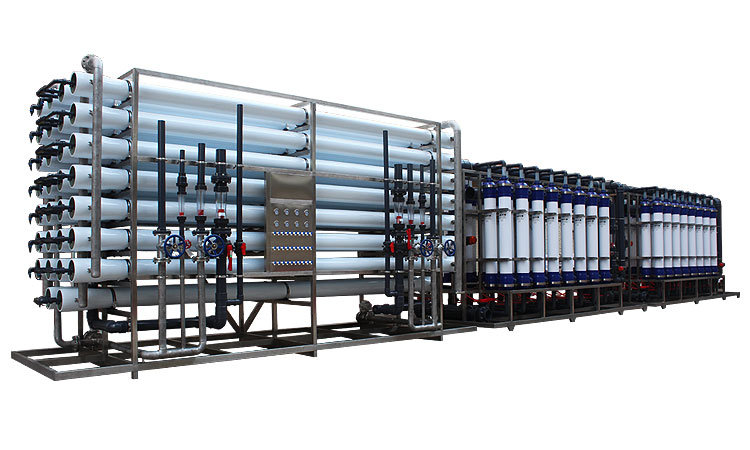 The “Magic” of Turning Seawater into Freshwater: Unveiling the Core Secrets of Reverse Osmosis Technology
 Introduction to Reverse Osmosis Water Treatment Equipment
 Why is reverse osmosis the “gold standard” for advanced water purification?