Introduction to Seawater Desalination Technology—Reverse Osmosis
Against the backdrop of increasingly scarce global water resources, seawater desalination technology has emerged as a vital solution to freshwater shortages. Among these methods, reverse osmosis has become a mainstream technology due to its high efficiency and energy savings. This article will take you deep into the core secrets of this technology.
I. Technical Principle
The heart of reverse osmosis lies in a specialized membrane—the reverse osmosis membrane. Imagine this membrane as an extremely strict “gatekeeper” that only allows water molecules to pass through, while firmly blocking the vast majority of salts, minerals, organic matter, bacteria, and viruses present in seawater. Its operation is driven by pressure differentials. Under normal conditions, water molecules naturally permeate from a low-concentration solution (freshwater) to a high-concentration solution (seawater). Reverse osmosis reverses this process. By applying a powerful pressure far exceeding seawater's natural osmotic pressure (typically between 5.5 and 8 megapascals), it forces seawater molecules to “swim against the current,” penetrating the reverse osmosis membrane to collect as freshwater. The blocked salts and other impurities become concentrated seawater (brine) that is discharged. This process is essentially a precise reversal and control of nature's osmotic phenomenon.
II. Process Flow
Though seemingly complex, the core process flow of a reverse osmosis desalination plant can be clearly summarized in four key steps:
1. Pretreatment
Upon entering the system, seawater undergoes rigorous purification. This critical step removes impurities that could clog or damage the subsequent precision reverse osmosis membranes. It typically includes:
(1) Flocculation/Sedimentation/Filtration: Removes suspended particles, silt, algae, etc.
(2) Security Filtration: Intercepts finer particles using precision filters (e.g., 5-micron cartridges).
(3) Disinfection: Inactivates microorganisms with disinfectants like sodium hypochlorite to prevent biofouling of membrane surfaces. Scale inhibitors may also be added to prevent salt scaling under high pressure.
2. High-Pressure Pumping
The pretreated seawater is pressurized by high-power pumps to the required reverse osmosis operating pressure (typically 55-80 atmospheres). This constitutes the system's primary energy consumption stage.
3. Reverse Osmosis Core
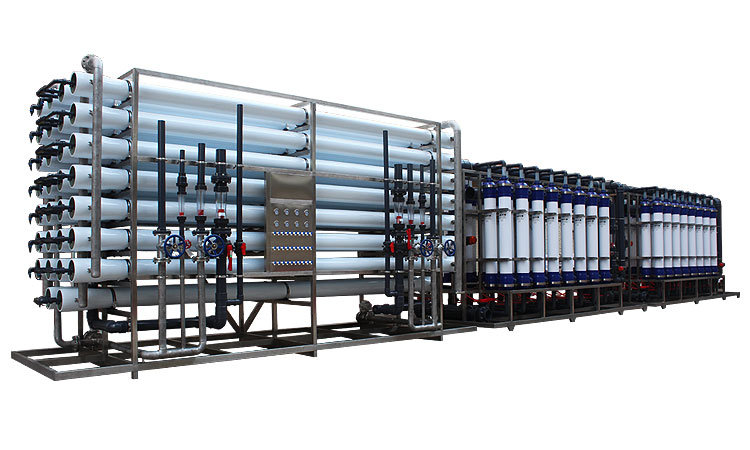
The pressurized seawater enters a pressure vessel assembly containing reverse osmosis membrane elements. Here, the miracle occurs: under high pressure, water molecules are forced through the membrane walls to become freshwater (product water). Dissolved salts, organic matter, and microorganisms are retained by the membrane, forming a higher-concentration brine solution (reject water). Multiple membrane elements are typically arranged in series or parallel configurations to enhance water production efficiency and recovery rates (usually 30-50%, meaning approximately one-third to half of the seawater is converted into freshwater). 4. Post-Treatment and Concentrate Disposal (1) Product Water Post-Treatment
Reverse osmosis product water is extremely pure. To meet drinking water or specific application standards, it often requires mineral addition to adjust taste (e.g., mineralization) or pH adjustment (e.g., adding alkali to neutralize acidity from carbon dioxide). Sometimes UV or chlorine disinfection is also needed to ensure microbial safety.
(2) Energy Recovery
The discharged brine retains significant pressure. Efficient systems incorporate energy recovery devices (e.g., PX pressure exchangers or turbochargers) to harness the pressure energy in the brine for reuse, substantially reducing high-pressure pump energy consumption (by up to 60%). (3) Brine Discharge
Proper brine management is a critical environmental consideration. Typically, brine is diluted and discharged back into the ocean via diffusers to prevent excessive salinity in localized areas that could harm ecosystems. Alternatively, resource recovery methods are explored.
III. Characteristics
Reverse osmosis stands out among desalination technologies due to its distinct advantages:
1. Lowest Relative Energy Consumption Compared to traditional thermal methods (e.g., multistage flash distillation, multi-effect distillation), reverse osmosis primarily consumes electrical energy to drive high-pressure pumps, eliminating substantial thermal energy requirements. This results in lower overall energy consumption and more competitive operating costs. Energy recovery technologies further enhance its energy efficiency.
2. Modular Design with Flexible Scalability: The system primarily consists of pumps, membrane modules, piping, and valves, facilitating modular design and factory prefabrication. Capacity can be flexibly adjusted by adding or removing membrane modules, enabling short construction cycles and excellent site adaptability.
3. Ambient Temperature Operation, Wide Applicability The entire process operates at ambient temperatures without requiring heating or cooling. This simplifies the process flow and broadens the selection range for equipment and materials.
4. High Degree of Automation It facilitates highly automated control and remote monitoring, simplifying operational management and reducing labor requirements. 5. Pure and Stable Water Quality The produced water is highly pure, achieving a desalination rate exceeding 99%. It effectively removes nearly all ions, organic substances, microorganisms, and particulates from the water.
IV. Advantages and Prospects
1. Advantages
The core strength of reverse osmosis lies in its optimal balance of high efficiency and relatively low cost. With continuous improvements in membrane performance (higher flux, enhanced fouling resistance, extended lifespan), optimized energy recovery systems, and advancements in pretreatment technologies, its energy consumption per ton of water and production costs have significantly decreased over the past decades, enhancing its economic competitiveness.
2. Prospects
(1) Mainstay of Large-Scale Applications It has become the preferred technology for new large-scale seawater desalination projects worldwide, particularly supporting massive water supply in severely water-scarce regions like the Middle East, North Africa, and China's coastal areas.
(2) Coupling with Renewable Energy Integrating with renewable energy sources such as wind power and photovoltaics to develop “green desalination” represents the ultimate direction for addressing its energy consumption challenges, holding immense potential. Direct solar photovoltaic-driven reverse osmosis systems have entered the demonstration and promotion phase. (3) Diversified water resource security extends beyond desalination. Reverse osmosis technology is also widely applied in brackish water desalination, advanced wastewater treatment for reuse (reclaimed water), and industrial pure/ultrapure water production, serving as a core technology for achieving water resource recycling and diversified security.
(4) Continuous Technological Evolution Research into novel cathode materials (e.g., graphene membranes), higher-efficiency membrane module designs, and smarter integrated control systems will propel reverse osmosis toward lower energy consumption, reduced costs, enhanced reliability, and greater intelligence.
Conclusion
With its exceptional separation efficiency and continuously optimized economics, reverse osmosis has become the core technology for modern seawater desalination. It serves not only as a practical solution to the freshwater crisis in coastal and island regions but also as a crucial component in building future sustainable water cycle systems. As technological innovation continues and costs further decrease, this “upstream force” will undoubtedly inject stronger blue vitality into global water security.
 The “Magic” of Turning Seawater into Freshwater: Unveiling the Core Secrets of Reverse Osmosis Technology
 Introduction to Reverse Osmosis Water Treatment Equipment
 Why is reverse osmosis the “gold standard” for advanced water purification?
 The ultimate leak prevention guide for home water filtration systems...