Comprehensive Guide to Pure Water Treatment Equipment: From Principles to Configuration, Master the Entire Water Purification Process in One Article
I. Core Principles and Process Flow
The core of pure water treatment lies in utilizing membrane technology for filtration, supplemented by pretreatment equipment to achieve water purification. Different water quality requirements correspond to different process routes:
1. Two-Stage Reverse Osmosis Pure Water Process (Preferred for High-Standard Purification)
Raw Water → Quartz Sand Filter → Activated Carbon Filter → Security Filter → Multistage Pump → First-Stage Reverse Osmosis Membrane (Concentrate Recovery) → Multistage Pump → Second-Stage Reverse Osmosis Membrane (Concentrate Recovery) → Purified Water
Features: Over 99% desalination rate, water quality meets national bottled purified water standards, suitable for large-scale applications like water plants.
2. Single-Stage Reverse Osmosis Purification Process (Basic Purification Solution)
Raw Water → Quartz Sand Filter → Activated Carbon Filter → Security Filter → Multi-Stage Pump → Single-Stage RO Membrane (Concentrate Recovery) → Purified Water 3. Mineral Water / Spring Water Process (Mineral Retention) Raw Water → Quartz Sand Filter → Activated Carbon Filter → Security Filter → Ultrafiltration Membrane → Mineral Water / Spring Water
Key: Ultrafiltration membranes feature larger pore sizes, filtering impurities while retaining natural minerals. 4. Ultrapure Water / Deionized Water Process (Research-Grade High-Purity Water) Raw Water → Pretreatment → Reverse Osmosis Membrane → Primary Mixed Bed → Secondary Mixed Bed → Ultrapure Water
Objective: Achieve resistivity of 1-15 MΩ·cm, removing nearly all ions.
II. Introduction to Filtration Stages
1. Quartz Sand Filter
Multi-layer quartz sand bed removes large suspended solids like silt and rust
Supports manual backwashing; filter media theoretically requires no replacement, only replenishment
Housing options: stainless steel or fiberglass; media capacity: 150-3000 kg
2. Activated Carbon Filter
Primarily uses shell-based activated carbon to adsorb approximately 60% of organic matter and catalyze residual chlorine decomposition (non-simple adsorption, no saturation issues, only carbon consumption). Output meets RO feedwater requirements. (SDI ≤ 4)
3. Security Filter
Includes built-in PP20-30 filter cartridges to remove fine particles and prevent RO membrane scratches. Normal lifespan exceeds 3 months. Stainless steel housing. 3-12 cartridges.
4. Reverse Osmosis Membrane (RO Membrane)
Primarily Hydranautics brand from the USA, specifications 4040/8040, quantity 1-20 units
Removes over 99% of inorganic salts, organic matter, bacteria, and viruses
Two-stage reverse osmosis achieves over 99% desalination rate, water recovery rate over 60%, lifespan 2+ years
5. Ultrafiltration Membrane
Domestic hollow fiber membranes, specifications 4040/8040
Removes bacteria and nearly all organic matter, water utilization rate 75-90%, resistant to clogging
6. Mixed Bed Equipment
Ion exchange resins (cation/anion) remove residual ions, available with regenerable/non-regenerable media
Outlet water resistivity 1-15 MΩ·cm, meets ultrapure water standards
III. Pure Water Plant Equipment Configuration
1. Two-Stage Reverse Osmosis Water Maker (RO-1000I Series)
Per QS certification requirements, pure water plant equipment must exceed 1T/H capacity. Thus, customer demands typically start at 1T+, with options including 1T, 2T, and 5T models. Two-stage reverse osmosis is mandatory for pure water plants to meet output standards (conductivity <10 μS/cm).
2. Fully Automatic Bottle Washing and Filling Machine (XG-100 Series)
This equipment is specifically designed for cleaning purified water containers and filling purified water. Utilizing pneumatic systems, it operates fully automatically from external washing through filling and capping. The washing process typically involves a four-station cycle: external wash → internal wash → disinfectant rinse → purified water rinse, followed by filling and capping. Based on filling capacity, models are categorized as single-row or double-row. Single-row units typically handle 60-120 bottles per hour, while double-row models process over 120 bottles per hour (e.g., 200, 400 bottles). By configuration, they are available in linear or L-shaped designs.
3. Stainless Steel Water Storage Tank (1-5T)
Pure water filtered by the reverse osmosis water maker is first stored in a stainless steel tank. After disinfection and preservation, it proceeds to filling. Tanks typically come in 1T, 2T, 3T, and 5T capacities, equipped with a liquid level switch that connects to the water maker for automatic filling and shutdown. Made of 304 food-grade stainless steel, the support frame can be either iron or stainless steel.
4. Ozone Disinfection System
For tanks under 1T: Select an ozone water generator (electrolyzes purified water to produce ozone).
For tanks over 1T: Select an ozone mixer (electrolyzes oxygen + mixing pump for more thorough disinfection).
5. Air Purifier (ZJ-800)
Specifically designed to purify air in filling rooms, ensuring sealed filling areas maintain Class 1000+ air cleanliness to prevent secondary contamination during purified water filling. One or two units may be installed based on room size.
6. Cap Sterilizer (XD-3)
Dual ozone + UV sterilization
IV. Mineral Water / Mountain Spring Water Plant Configuration
Core Equipment: Ultrafiltration Water Purifier (1-15T production capacity, retains minerals)
Other pretreatment and filling equipment identical to purified water plants; no water softener required
V. Ultrapure Water Equipment (Research/Industrial Use)
1. Single-stage or dual-stage reverse osmosis units serve as pretreatment for ultrapure water systems, removing most impurities, bacteria, and ions to ensure desalination efficiency of downstream equipment. 2. Single-stage or dual-stage mixed-bed ion exchangers utilize cation and anion resins to further remove ions, achieving required water resistivity.
3. Stainless steel storage tanks hold ultrapure water.
4. Stainless steel booster pumps pressurize the ultrapure water in storage tanks for delivery to designated workstations.
VI. Unit-Level Pure Water Equipment (Office/Canteen)
Single-stage/Double-stage reverse osmosis water purifier (0.3-1T/H; double-stage for northern regions, single-stage for southern regions)
Storage tank + Booster pump + Ozone water generator
Water Purification Tips
After ozone disinfection, store for over 12 hours to allow ozone decomposition into oxygen, preventing residual odors.
Install a fully automatic water softener when raw water hardness exceeds 500 to prevent RO membrane scaling.
Equip filling rooms with air showers to prevent personnel-introduced contamination.
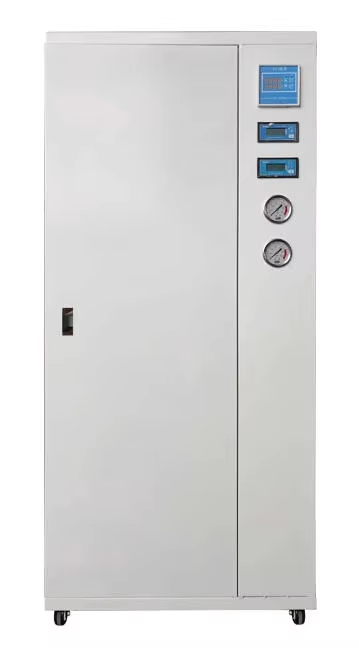 Analysis of the Structure and Working Principle of Ultrapure Water Equipment
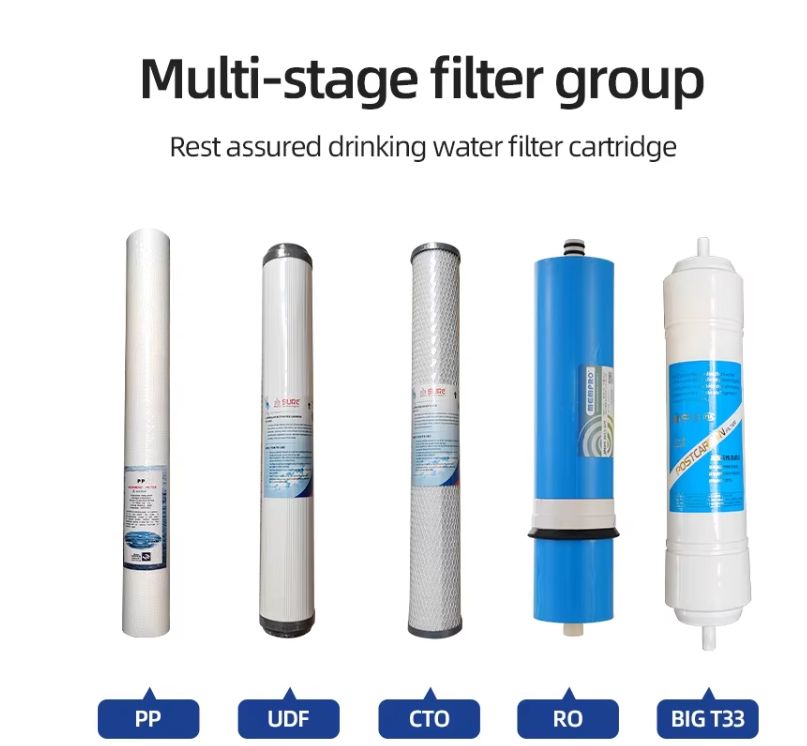 Tips for Using Home Water Purifier Filter Cartridges
 The Battle of Four Membranes: Microfiltration, Ultrafiltration, Nanofiltration, Reverse Osmosis—Which Reigns Supreme in Water Purification?
 Don't Pay for Stupidity! The Ultimate 2026 Water Purifier Guide: Selection, Pitfalls, and Maintenance All in One Article